What we do
Children with hip developmental disorders are at risk of progressive deformity, hip instability and resulting pain, restricted mobility and early osteoarthritis.
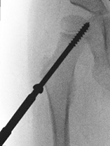
Guided growth uses remaining growth potential to gradually correct hip deformity with temporary minimally invasive transphyseal fixation. In this study we analyse guided growth in children with a full range of underlying disorders, including neuromuscular, developmental and growth disturbances.
In this multicentre cohort we follow childrenduring growth to evaluate hip morphology changes and patient-reported outcomes.
The project aims to define safe implementation of guided growth as an early, low-burden intervention to prevent hip displacement.
Guided growth uses remaining growth potential to gradually correct hip deformity with temporary minimally invasive transphyseal fixation. In this study we analyse guided growth in children with a full range of underlying disorders, including neuromuscular, developmental and growth disturbances.
In this multicentre cohort we follow childrenduring growth to evaluate hip morphology changes and patient-reported outcomes.
The project aims to define safe implementation of guided growth as an early, low-burden intervention to prevent hip displacement.
We analyse femoral head sphericity, acetabular development and joint congruency using advanced 2D/3D metrics and AI-assisted imaging.
Patient-reported outcomes cover well-being, mobility, pain, fatigue, sleep and disorder-specific functional limitations.
Subgroup analyses assess how underlying pathology and growth potential influence correction speed and hip stability.
Long-term follow-up integrates morphological and PROM trajectories to determine safety and functional prognosis.
Patient-reported outcomes cover well-being, mobility, pain, fatigue, sleep and disorder-specific functional limitations.
Subgroup analyses assess how underlying pathology and growth potential influence correction speed and hip stability.
Long-term follow-up integrates morphological and PROM trajectories to determine safety and functional prognosis.
This study is generously supported by a JKF Kinderfonds research grant (https://www.jkf-kinderfonds.nl/)
Amsterdam UMC
UMC Groningen
Maastricht UMC+
Sint Maartenskliniek
Medisch Spectrum Twente
TU Delft