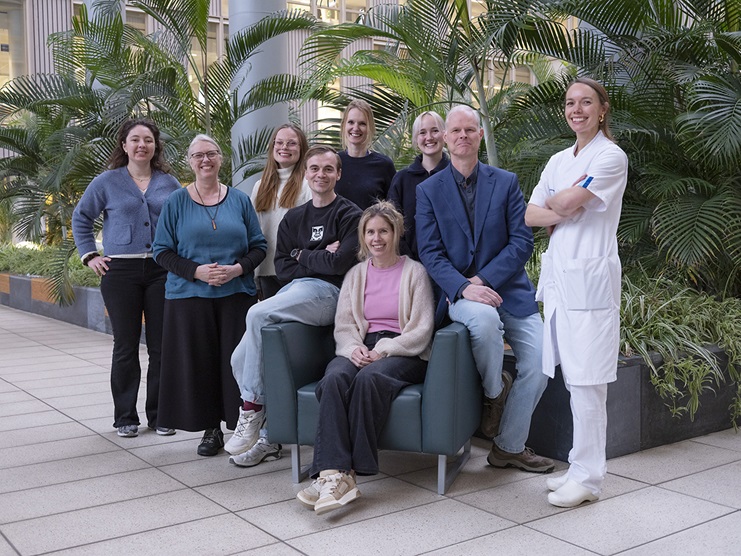
About our research group/lab
Our research
Our research focusses on people with a genetic predisposition to gastrointestinal cancer especially Lynch syndrome and Peutz-Jeghers syndrome, but we are also involved in research regarding other hereditary GI-tumor syndromes
Lynch syndrome Other hereditary GI-tumor syndromes Other syndromes with a hereditary GI-tumor risk are for example Familial Adenomatous Polyposis (FAP), MUTYH-associated Polyposis (MAP), Juvenile Polyposis syndrome (JPS) and PTEN Hamartomatous Tumor syndrome (PHTS). We also study these rare syndromes and collaborate nationally and internationally to improve the diagnosis and care for carriers of these syndromes.
Lynch syndrome (LS) is the most common hereditary predisposition to colorectal cancer (CRC). It is caused by germline pathogenic variants (PV) in DNA mismatch repair (MMR) genes or deletion of the 3’end of EPCAM. Carriers of an MMR PV are at high lifetime risk of up to about 60% of developing CRC, compared to about 5% in the general population. Also, there is a risk of other cancers especially endometrial cancer in female PV carriers. Surveillance of Lynch syndrome carrierslargely decreases their risk of developing cancer. Our research focuses on improving the detectionof LS and prevention of LS associated tumors. An overview can be obtained from the doctoral theses from our group for which you find the links below.
Peutz-Jeghers syndrome
Peutz-Jeghers syndrome (PJS)is a rare predisposition tohamartomatous gastrointestinal polyps and cancer. It is caused by PV in the STK11-gene and inherits in an autosomal dominant way. Carriers also have characteristic pigmentations of the lips and saliva. We focus on determiningthe (cancer) risks associated with this syndrome and on improving surveillance for Peutz-Jeghers syndrome carriers. See also the doctoral theses from our group via the links below.
Towards improved detection and management of Lynch Syndrome
Peutz-Jeghers syndrome and cancer linked by LKB1
Diagnostic Strategies for Early Lynch Syndrome Detection: From Molecular Testing to Economic Evaluation
Lynch Syndrome Improving Diagnostics and Surveillance
Detection, management and prevention of Lynch syndrome associated tumors
Lynch surveillance study
This ongoing study in collaboration with the Gastroenterology department evaluates the current managementof GItumor risks in LS carriers and investigates how surveillance and prevention can be optimized.
ENDOMET LYNCH
In collaboration with the Gynecology department recently the ENDOMET LYNCH study was initiated to evaluate gynecological surveillance in Lynch carriers and evaluate a home-test for endometrial cancer.
SMART study
This study,in collaboration with the Oncology department,tries to develop a ctDNA based blood test to improve early detection of colorectal cancer in LS carriers, and maybe also other cancers for which no good surveillance is available at the moment.
PREDI-LYNCH
This is a European collaboration in order to validated non-invasive liquid biopsy tests for cancer PREDIction in LYNCH syndrome.
A high incidence of MSH6 mutations in Amsterdam criteria II-negative families tested in a diagnostic setting. Ramsoekh D, Wagner A, Leerdam ME van, Dinjens WNM, Steyerberg EW, Halley JJ, Kuijpers EJ, Dooijes D. (2008). Gut. 2008 Nov;57(11):1539-44.
High cancer risk and increased mortality in patients with Peutz-Jeghers syndrome.
Van Lier MG, Westerman AM, Wagner A, Looman CW, Wilson JH, de Rooij FW, Lemmens VE, Kuipers EJ, Mathus-Vliegen EM, van Leerdam ME. (2011). Gut. 2011;60(2):141-7.
Yield of routine molecular analysis in colorectal cancer patients <70 years to detect underlying Lynch syndrome.Van Lier MG, Leenen CH, Wagner A, Ramsoekh D, Dubbink HJ, van den Ouweland AM, Westenend PJ, de Graaf EJ, Wolters LM, Vrijland WW, Kuipers EJ, van Leerdam ME, Steyerberg EW, Dinjens WN; LIMO Study Group. (2012). J Pathol. 2012 Apr;226(5):764-74.
Somatic aberrations of mismatch repair genes as a cause of microsatellite-unstable cancers. Geurts-Giele WR, Leenen CH, Dubbink HJ, Meijssen IC, Post E, Sleddens HF, Kuipers EJ, Goverde A, van den Ouweland AM, van Lier MG, Steyerberg EW, van Leerdam ME, Wagner A, Dinjens WNJ. (2014). Pathol. 2014 Dec;234(4):548-59.
Cost-effectiveness of routine screening for Lynch syndrome in colorectal cancer patients up to 70 years of age.Leenen CH, Goverde A, de Bekker-Grob EW, Wagner A, van Lier MG, Spaander MC, Bruno MJ, Tops CM, van den Ouweland AM, Dubbink HJ, Kuipers EJ, Dinjens WN, van Leerdam ME, Steyerberg EW. (2016). Genet Med. 2016 Oct;18(10):966-73.
Cost-effectiveness of routine screening for Lynch syndrome in endometrial cancer patients up to 70years of age.Goverde A, Spaander MC, van Doorn HC, Dubbink HJ, van den Ouweland AM, Tops CM, Kooi SG, de Waard J, Hoedemaeker RF, Bruno MJ, Hofstra RM, de Bekker-Grob EW, Dinjens WN, Steyerberg EW, Wagner A, LIMO study group. (2016). Gynecol Oncol. 2016 Dec;143(3):453-459.
Small-bowel Surveillance in Patients With Peutz-Jeghers Syndrome: Comparing Magnetic Resonance Enteroclysis and Double Balloon Enteroscopy. Goverde A, Korsse SE, Wagner A, van Leerdam ME, Krak NC, Stoker J, van Buuren HR, Hofstra RM, Bruno MJ, Dewint P, Dekker E, Spaander MC. (2017). J Clin Gastroenterol. 2017 Apr;51(4):e27-e33.
Routine Molecular Analysis for Lynch Syndrome Among Adenomas or Colorectal Cancer Within a National Screening Program.Goverde A, Wagner A, Bruno MJ, Hofstra RMW, Doukas M, van der Weiden MM, Dubbink HJ, Dinjens WNM, Spaander MCW. (2018). Gastroenterology. 2018 Nov;155(5):1410-1415.
The management of Peutz-Jeghers syndrome: European Hereditary Tumour Group (EHTG) Wagner A, Aretz S, Auranen A, Bruno M. J., M. Cavestro G, Crosbie E.J., Goverde A, Jelsig A,M., Latchford A, van Leerdam M.E., Lepisto A, Puzzono M, Winship I, Zuber V, Möslein G. Guideline. J Clin Med 2021 Jan 27;10(3):473
Unexplained mismatch repair deficiency: Case closed. Eikenboom EL, Moen S, van Leeuwen L, Geurts-Giele WRR, Tops CMJ, van Ham TJ, Dinjens WNM, Dubbink HJ, Spaander MCW, Wagner A. HGG Adv. 2022 Dec 14;4(1):100167
Metachronous Colorectal Cancer Risk according to Lynch syndrome pathogenic variant after extensive vs partial colectomy in the Netherlands: a retrospective cohort study. Lancet Gastroenterology 2023. Eikenboom EL, Moen S, Leerdam ME. van, Papageorgiou G, Doukas M, Tanis PJ, Dekker E, Wagner A, Spaander MCW. Dec;8(12):1106-1117
Outcomes of endometrial cancer prevention strategies in patients with Lynch syndrome: a nationwide cohort study in the Netherlands. Eikenboom EL, Van Leeuwen L, Groenendijk F, Woolderink JM, Van Altena AM, Van Leerdam ME, Spaander MCW, Van Doorn HC and Wagner A. EClinicalMedicine. 2024 Dec 21:79:103006. PMID: 39816931
The clinicopathological features of breast cancer in Peutz-Jeghers syndrome: results from an international survey.
Elizabeth Loehrer, Anja Wagner, Massiah Bahar, F Rubab Ramzan, Anne Marie Jelsig, Anne Goverde, Monique van Leerdam, Susanne E Korsse, Evelien Dekker, Manon C W Spaander, John Gásdal Karstensen, Veronica Zuber, Finlay Macrae, Andrew Latchford. Fam Cancer. 2025 May 3;24(2):41. doi: 10.1007/s10689-025-00469-5 PMID: 40317347
Large-and medium-sized arterial aneurysms in two patients with SMAD4-related juvenile polyposis syndrome. Weelden W van, Bleeker FE, Stijn D van, Micha D, Maugeri A, Kuijpers TW, Koch AD, Aalfs CM, Wagner A, Groenink M, Oldenrijk J van, Baars MJ, Duijker FAM. Am J Med Genet 2024 Oct:194(10) PMID38752492
Prevalence and Consequences of APC Mosaicism in Patients With Colorectal Adenomas. Terlouw D, Suerink M, Buitelaar Y, van Leerdam ME, Hes FJ, van Egmond D, Ruano D, Wagner A, Groenendijk FH, Meijssen IC, Overwater E, Bajwa-Ten Broeke SW, Mensenkamp AR, Nagtegaal ID, Tops CM, Langers AMJ, van Wezel T, Morreau H, Nielsen M. Gastroenterology. 2026 Mar 9:S0016-5085(25)06210-9. doi: 10.1053/j.gastro.2025.10.028. Online ahead of print. PMID: 41801175
An accurate cellular assay to determine pathogenicity of coding and noncoding variants in Lynch syndrome genes. Proc Natl Acad Sci U S A. Glykofridis IE, Dekker M, Stoepker C, Ravesteyn TW van, Tiersma Y, Ham CG van der, Bruijn B de, Ebrahim S, Menezes RX de, Kasteleijn E, Verheijen F, Ham TJ van, Te Riele H. 2026 Jan 20;123(3):e2517801123.PMID: 41543911
Collaboration within Erasmus MC
Our group has a long-standing collaboration with the Erasmus MC departments of Gastroenterology & Hepatology (V.M.C.W. Spaander, P. van Riet, J. Honing, M.J. Bruno), Gynecology (H.C. van Doorn, C van den Berg, H van Beekhuizen) and Pathology (H.J.Dubbink, F. Groenendijk) and other collaborators within the Center for Familial and Hereditary Tumors(see below) of the Erasmus MC Cancer Institute regarding the detection and prevention of hereditary gastrointestinal tumors.
Collaboration outside of Erasmus MC
We collaborate nationally with other genetic centers e.g. with the LUMC on adenomatous polyposis and with the Radboud MC on PHTS. We are also an active partner in the NESTOR-consortium, that registers all individuals with a genetic predisposition for cancer and thereby stimulates research in this field.
Nationally there is a good collaboration with the foundation for the detection of hereditary tumors (StOET). We are actively involved in the INVUSE consortium, which is dedicated to classify variants of unknown significance in MMR genes. Within the NESTOR consortium we contribute to a national registry of people with a hereditary cancer predisposition, At European level we are member of the ERN. GENTURIS, contributing to guidelines and international research.
2022 , KWF-14976 , Smart measurement of circulating tumour DNA: a tumour-agnostic computational tool to improve colorectal cancer care, leading WP3
2024 , KWF-15909 , NESTOR, building the infrastructure for the Netherlands tumour risk registry, local coordinator and steering committee
2024 , Horizon Europe Cancer Mission grant: , Validated non-invasive liquid biopsy tests for cancer PREDIction in LYNCH Syndrome (PREDI-LYNCH), PI clinical trial
2025 , KWF-17386 , Home-based DNA methylation self-test for endometrial cancer surveillance in women with Lynch syndrome, leading WP2