This video shows you how your admission will go and what you can expect:
About your admission to the hospital
Before your admission, you will receive a letter from us telling you on which date we will admit you to the hospital and at what time. This letter will also tell you where to go when you arrive at the hospital.
Filling in this questionnaire ahead of time helps the nurse prepare for when you come in. That way, your intake interview will be a quicker and smoother experience. Lots of patients find the questionnaire to be a great way to prepare.
The questionnaire is available in Dutch, English, French and German. More languages will be available soon.
Questionnaire
Three days prior to your scheduled admission date, you will receive a questionnaire via the patient portal. This questionnaire allows you to share important information with us, about your health, medication, home situation and how you are feeling, for example. You can also use it to tell us what's important to you during your stay at the hospital.Filling in this questionnaire ahead of time helps the nurse prepare for when you come in. That way, your intake interview will be a quicker and smoother experience. Lots of patients find the questionnaire to be a great way to prepare.
The questionnaire is available in Dutch, English, French and German. More languages will be available soon.
Unable to attend
If you are unable to come in on the scheduled date, please let us know as soon as possible.MRSA and HRMO infection
In some situations, you are at higher risk of MRSA or HMRO infection. These infections are caused by bacteria that are resistant to most antibiotics. Hospitals in the Netherlands are taking special measures to stop these bacteria from spreading. One of these measures is to isolate any patients who are or may be carrying these bacteria from other patients while they are at the hospital. If any of the situations below apply to you, please let the doctor or nurse at the admitting department know as soon as possible.- you have received treatment or been admitted to a hospital abroad in the last two months
- you work with pigs, veal calves and/or poultry
- you are a seafarer
- you are (known to be) a carrier of resistant bacteria from another hospital or care provider
Your medication
It is important for the doctor to know which medication you are taking. This includes any medicines you get from the chemist or health food store, as combining medication may be harmful to you. Your doctor will decide whether you should continue taking this medication and will discuss which other medication you will need.Fake nails or nail varnish
You should not be wearing any fake nails or nail varnish on the day of your procedure. If you are wearing fake nails or nail varnish, please remove these from your index finger and middle finger on both hands as a minimum. We ask this because we use a device attached to your index finger or middle finger to measure the oxygen level in your blood.Please bring proof of identity every time you visit Erasmus MC. You will need this when you register or sign in. You can use your passport, identity card, residence permit or driving licence to do so.
A discount is available for people visiting a patient at the hospital, as well as for patients visiting an outpatient clinic. You can read more about this on our 'Parking discounts' page.
No parking is available near the main entrance at Dr Molewaterplein 40. You can get someone to drop you off here, however. Wheelchairs are available at the entrance for you to use — please return these when you're done.
Parking
Paid parking is available in the multistorey car parks on Westzeedijk or Wytemaweg. More information about the options for parking can be found on the Contact & Getting here page of our website.A discount is available for people visiting a patient at the hospital, as well as for patients visiting an outpatient clinic. You can read more about this on our 'Parking discounts' page.
No parking is available near the main entrance at Dr Molewaterplein 40. You can get someone to drop you off here, however. Wheelchairs are available at the entrance for you to use — please return these when you're done.
Signing in at the entrance
If you have been to Erasmus MC before, simply use one of the sign-in kiosks near the entrance. Scan your proof of identity at the kiosk — the kiosk will tell you where to present your passport, identity card, residence permit or driving licence. You will then receive a day ticket showing the route to take to the floor where you will be admitted.Registering
If you are visiting Erasmus MC for the first time or if we need more information from you, you can register at the registration desk. To find the desk, simply follow the 'Inschrijven/Registration' signs, or ask one of our hosts to show you the way. Once you've been registered, our staff will give you a day ticket showing the route to take to the floor where you will be admitted.Need to have a blood sample taken first?
In some cases, the letter you received will tell you to go to Phlebotomy first to have a blood sample taken. Your day ticket will show you the route to our Phlebotomy ward.Too early for your appointment
If you've got some time to spare before your appointment, feel free to take a look around our shops or enjoy a break in one of our restaurants, courtyard gardens or waiting areas.Signing in on your floor
Make your way to the clinic using the directions on your day ticket and the signs around the hospital. Once you get to your floor, scan the barcode on your day ticket at the kiosk there, so that we know you've arrived. Take a seat in the lounge and someone will come get you. Once again, our hosts on the floor will be happy to help you.Medication interview
If your admission letter says you're scheduled in for a medication interview first, your day ticket will tell you where to go for this interview. During this interview, one of our pharmacy assistants will run through your medication with you and add this information to your file. Once the medication interview has finished, simply proceed to the floor where you will be admitted. If you haven't yet given your consent for details of your medication to be shared via the Landelijk Schakelpunt/National Exchange Point, we would appreciate it if you could do so now. The pharmacy assistant can use the National Exchange Point to request an overview of the medication you are taking from your own pharmacy. Your pharmacy is only allowed to share these data if you have given your prior consent for them to do so.What to bring
Only limited space is available in your room, so please don't bring too many things. It is better to leave any valuables at home, as the hospital accepts no liability for any loss or theft. Things you should bring include:- Valid proof of identity. 'Valid' means that your proof of identity must not have expired. This can be a valid Dutch passport, an identity card or a residence permit.
- Your DigiD login details. Your can use these login details to log into My Erasmus MC, where you can view your file.
- Nightwear.
- Underwear.
- Toiletries.
- Dressing gown or jacket.
- Slippers with a non-slip sole.
- Something to read or a game to play.
- The medication you take at home in its original packaging.
- You do not need to bring an overview of your medication. If you have given your consent, we can access details of the medication you are taking. You can sort this out via your GP, your pharmacy or via www.ikgeeftoestemming.nl
- Any dietary instructions.
- Your mobile phone (you may need this if you go out to the rooftop garden, for example).
Your initial welcome at the hospital
One of our hosts will welcome you to the hospital. You can then take a seat in the lounge. One of our non-clinical staff will come get you and will show you the way to your single room. They will explain how to use the patient tablet to control the light, heating and blinds in your room. You can also use this tablet to order meals, view your file using your DigiD details, call a member of our non-clinical staff or use the internet. Your tablet will also show you details of your main practitioner and your provisional discharge date. You will then be introduced to a nurse, who will ask you some questions that are important for your treatment and care. This may include questions about what you can do yourself, what you need help with, and whether you have any dietary requirements.Contact
The nurse will ask you to provide details of someone to contact. For privacy reasons, we carefully control with whom we share information about you. With that in mind, we would appreciate it if you could designate one person among your family and friends to liaise with the hospital. This contact can call the hospital at any time to ask how you are doing.Your room
Your room comes with its own toilet and bathroom. There is a nurse call button near your bed that you can use to call your nurse at any time. Every room has a TV with a large range of channels and radio stations. You can use the internet on the tablet, radio and TV free of charge.A 'rooming in' chair is available in your room. This chair can easily be converted into a bed when the doctor or nurse asks one of your loved ones to stay overnight or watch over you if you are in a state of severe confusion, for example. Rooming in is only possible if genuinely necessary and in consultation with your doctor. Sometimes, you may need to move to another room for organisational reasons. You can read more about this on the 'rooming in' page.
Patient ID wristband
For your own safety, it is important that we know who you are, so that we don't confuse you for another patient. When you arrive at the hospital, you will be given a patient ID wristband: a plastic wristband with your name, date of birth and ward on it. You need to wear this wristband at all times. We need to be absolutely sure that we carry out any tests on the right person, and that we give any medication to the right person. To avoid confusion, we may keep asking you for your name and date of birth (before every test, round of medicine and so on), even if you are wearing your wristband. We do this to double check. We kindly ask for your patience — we do this for your own safety. If your wristband is damaged or has been removed as part of a test or operation, please ask us for a new one.Alarm wristband
Aside from your patient ID wristband, you will be given another wristband with an alarm button. You can use this alarm button if you are unable to reach the nurse call button near your bed. This may be the case if you are in the bathroom or on the toilet, or if you decide to leave your room. When you press the alarm button, the nurse can see where you are and will come see you if necessary. Please consult with the nurse before leaving your room. They will make a note of your mobile number, so that they can call you if you press the alarm button. Please return your alarm wristband to us when you are discharged. These wristbands remain the property of Erasmus MC, and we will reuse them. Please do not dispose of them or take them home. In fact, they are of no use to you at home.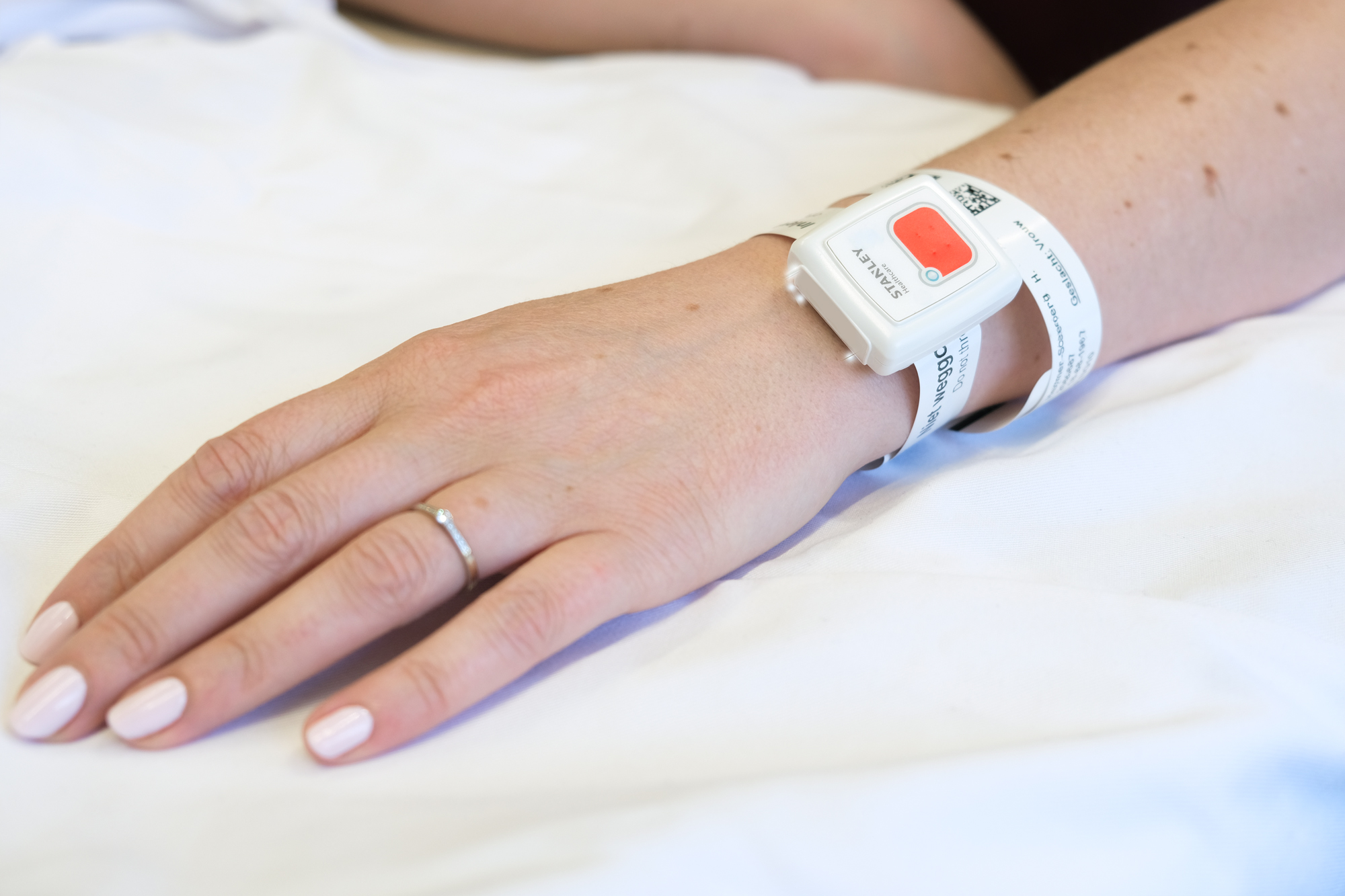
Clothing and exercise
If you do not need to stay in your bed, you can wear your own clothing as normal. Stay active if possible and if allowed — this will aid your recovery. We recommend getting out of bed regularly and taking short walks. If you need any help doing so, you can ask a nurse. If you decide to go for a walk, we would appreciate if you could bear in mind any mealtimes, treatments and tests you may have coming up. To reduce the risk of falling as much as possible, patients are not allowed to walk around the hospital without any footwear. To prevent any trips, it is best if you wear shoes or slippers with an anti-slip sole. For your own safety and in the interest of your treatment plan, please consult with the nurses before leaving the floor. Needless to say, patients must not leave the hospital premises.Lounge
A lounge is available on every floor of the hospital. You can spend time in this lounge whenever you wish, to meet with other patients, for example, to share a meal, or to receive your visitors. Free coffee and tea is provided in the lounge.Family room
The family room in the lounge is intended for relatives and visitors of patients who are in a serious condition. You can also use this room to have private conversations if you are unable to do so in your own room.Rooftop garden
You can find our rooftop garden from the eighth floor. This garden is freely accessible to patients, visitors and staff. Even so, please do always check with your nurse whether you are able to visit the rooftop garden. The rooftop garden is only open in spring and summer. To see the opening times of our rooftop garden, visit: Facilities - Erasmus MC.Use of mobile phones
Using a mobile phone is permitted in most places at Erasmus MC. In places where mobile phones are not allowed (including in intensive care), you'll see a prohibition sign. The rules of conduct for using your mobile phone are as follows:- please put your phone in silent or vibration mode
- keep your voice down
- find a spot where you disturb as few people as possible
- switch your phone off in areas where using it is prohibited
Wi-Fi
You can access the internet free of charge at Erasmus MC via our wireless network. Our Wi-Fi network is called 'Hotspot' and is available on all floors of the hospital, in nearly all public spaces, and in most outpatient clinics. Everyone is free to use this service. Simply connect your phone, tablet or laptop to the 'Hotspot' network using a web browser and navigate to a website of your choice. You will then see a page on which we'll ask you to agree to some rules of conduct and terms. Once you've done so, the connection will be available.Meals
You can order hot meals using your patient tablet. Only meals that suit your dietary requirements will be shown. You can also tell us where and at what time you would like to eat. For your sandwiches, one of our non-clinical staff will come round with a buffet trolley. You're free to pick anything you like. You can use your patient tablet to check which options suit your dietary requirements beforehand, and to see what's on the buffet trolley. We will make a note of your dietary requirements and meal preferences in your file when you are admitted. It is important that you eat and drink, including during your time at the hospital. Please make sure that you get enough to eat and drink, if you are able to and allowed. You can ask the staff on the ward whether there is a fridge to store your own food or drink. This is sometimes available in one of the seating areas.Hygiene
As a patient, you are more susceptible to infections. On top of that, you can also pass on bacteria, viruses and fungal infections to others. For that reason, we ask that you follow the general hygiene measures below:- Regularly wash your hands, and always do so in the following cases:
- After going to the toilet or after using a bedpan or urinal
- Before you start eating
- When your hands are dirty or sticky
- After coughing or sneezing into your hands
- After blowing your nose
- After spitting or vomiting
- Follow the correct coughing and sneezing hygiene:
- Cough or sneeze into a tissue or into the inside of your elbow, with your face turned away from others
- Use paper tissues, not cotton handkerchiefs
You are allowed to have flowers in your room, but please use disposable vases to hold them. Live plants are not permitted, as the potting soil contains fungi and bacteria that can cause infections.
Smoke-free Erasmus MC
Smoking is not permitted in and around the hospital.Visiting hours
You can find the visiting hours for the hospital on the following website: www.erasmusmc.nl/patientenzorg/bezoektijden. Please make arrangements with your visitors for when you would like to rest. No more than two visitors are allowed at any one time. When you are undergoing a test or treatment, we may ask your visitors to leave the room for a moment.
Hygiene for visitors
Visitors can transmit bacteria, viruses and fungal infections to patients, staff and other visitors. For that reason, visitors must follow the general hygiene measures below:- Please use the visitor toilets — ask the nurse where they are. The toilets in the patient rooms are not for visitor use.
- Wash your hands after going to the toilet. Instructions about hand hygiene after going to the toilet are displayed in the visitor toilets.
- Do not touch any wounds, catheters, bandages or other nursing/medical equipment.
- If you have diarrhoea, a fever, a cold or the flu, please contact the nurse before coming to the hospital.
Code of conduct
A code of conduct applies to patients and visitors at Erasmus MC:- At Erasmus MC, we treat one another with respect. Nuisance behaviour, physical and verbal violence, threats, (sexual) harassment, discrimination or any other unacceptable behaviour is not permitted.
- Weapons and dangerous objects are prohibited: these will be confiscated.
- Smoking, alcohol and drugs are prohibited: anyone found using these substances will be spoken to.
- We respect one another's property: theft and destruction are criminal offences.
- Making photos, videos and sound recordings is prohibited: to protect the privacy of patients, visitors and staff, spreading such recordings on social media is also not allowed.
Ward round
A doctor will visit you every day. We refer to this as the ward round. During this visit, the doctor will tell you how your treatment is progressing and what to expect next. You can also ask questions or raise any other issues.Your treatment team
You will be cared for by a team of nurses, doctors and other care providers.- Doctor on duty: this doctor will oversee your everyday medical care. You will see this doctor during the ward round. You can ask them any questions you may have about your medical treatment. If you or your relatives would like to have a conversation with this doctor, you can absolutely do so — the nurse will make an appointment for you.
- Nurses: the nurses are in charge of your everyday care. They are your first point of contact. You can ask them any questions you may have about your care.
- Trainee care providers: Erasmus MC is a teaching hospital. That's why you'll see more care providers around your bed here than you would at most hospitals.
- Medical students: medical students training to be doctors.
- Junior doctors: doctors who are training to be specialists.
- Trainee nurses: student nurses who are doing an internship.
- Non-clinical staff: these members of staff are happy to help if you need anything, such as a glass of water or an extra pillow. You can ask these members of staff to help you with something by tapping the service call button on your tablet.
- Office staff: If you have a question about your insurance documentation, hospital transport or appointments at the outpatient clinic, simply visit the office, who will be happy to help you out.
Medication and medical aids
While you are admitted to the hospital, you will get your medication from the hospital pharmacy. In some cases, the medicine you are taking may not be immediately available. If so, you can use your own stock, or the pharmacy will arrange an alternative in consultation with the doctor overseeing your treatment.If you are given any different or extra medication, feel free to ask why. If you are allergic to certain medicines, foods or other substances, please let your doctor and the nurses know. They will make a note of this in your digital file and take this into account as part of your treatment.
We will regularly ask you if you are in any pain. Together with you, we will explore what we can do about this. Our aim is to bring your pain down to a level that's bearable to you.
Our nurses will wear a yellow medication vest while handing out medication. Please do not disturb them when they are wearing this vest — we ask this to limit any mistakes on the medicine rounds to a minimum.
Your medication may be adjusted during your admission. We will give you a new overview to take home when you are discharged. If necessary, we will also give you a prescription or the medication you need.
If you need any medical aids, such as crutches, a wheelchair or bandages, please discuss this with the nurse in good time. The nurse will then be able to arrange these medical aids for you with the pharmacy or home care store. Please note: some medical aids will not be refunded by your insurance provider.
Resuscitation: your choice
We believe it is important to involve patients as much as possible in their treatment. We also believe it is important that you let us know your wishes and any boundaries regarding your treatment and resuscitation when you are admitted. For that reason, we will ask you about your resuscitation preferences when you are admitted (if you are aged 16 or over).Transport following discharge
We ask that you arrange your own transport home. A relative or friend could pick you up, for example. If you are unable to arrange your own transport due to your condition, for example, we will explore alternative options together, such as a taxi or hospital transport. Often, you will need to pay an excess for this. Ask your nurse about the options.You will usually return home between 09:00 and 10:00 in the morning, so please make sure that you are ready to be picked up at that time.
On the day of your discharge: the discharge interview
On the day of your discharge (or sometimes the day before), you will have a discharge interview with the nurse, and if necessary, with the doctor overseeing your treatment. We will discuss the following with you during this discharge interview:
- When you are able to go home,
- What to look out for at home,
- Which aftercare has been arranged (if necessary),
- What to do in case of complications or problems,
- Which appointments you have at the outpatient clinic.
- A medication overview,
- Any prescriptions, and if necessary, your medication. In some cases, you may need to collect your medication from the pharmacy yourself.
- Your GP and/or other care providers will receive a handover letter.
Checklist – Returning home fully prepared
This checklist can help you keep a clear overview of what you need to arrange to be safely discharged from hospital.- Discharge and transport:
- Do you know when you are able to go home and who will pick you up?
- Have you been able to arrange transport back home?
- Do you know whether you need to pay for this?
- Medication and medical aids:
- Have you got all your medication?
- Have you received sufficient information about your medication and the side effects?
- Have you got an up-to-date medication overview to use at home or for your pharmacy?
- Do you need any medical aids or nursing equipment? Have these been requested, or have you got them to take home?
- Care and support at home
- Do you need any extra care or support at home?
- Do you know which care you are due to receive after discharge? Do you know who will be providing this care?
- Have your loved ones or informal carers got enough information about your situation and which care you need?
- Follow-up ad contact:
- Do you know which appointments you have at the outpatient clinic?
- Do you know where and when your next checkup or appointment is?
- Do you know when to contact the hospital or outpatient clinic?
- Do you know how to contact the hospital or outpatient clinic if you have any questions or problems?
- Recovery and complications
- Do you know what to do in case of complications, side effects or medical questions?
- Do you know which specific symptoms to look out for once you've been discharged?
- Do you know what you can and cannot do once you've been discharged? (This includes any lifestyle rules about diet, exercise, wound care, work or driving a car)
- Peer and other support
- Have you received information about patient associations or other forms of support? If you have any more questions about this, you can ask the nurse on your ward.
Aftercare Office
In some cases, you may need aftercare following your admission to the hospital. This aftercare can come in various forms, such as:- Temporary admission for rehabilitation or step-down care
- Home care
- Hospice care
- Permanent admission to a care facility
You can specify one preferred location for your aftercare. We will always try to make sure you can attend this location first. Unfortunately, this is not always possible. This may be because there is no space at the location of your choice, or it is not suitable for your recovery needs. What matters most is that you can access a place that gives you the right care in good time. For that reason, you may need to attend a different location. If you do not agree with your aftercare location, please discuss this with the doctor and your loved ones.
Once you are ready to leave Erasmus MC, it is important that you cooperate with your departure from the hospital. This is important for the hospital, but best for you too. By that point, staying at the hospital will not help you — it is no longer the best place to work on your recovery. On top of that, it is also important that your bed is freed up for other patients who need care.
My Erasmus MC
As a patient of Erasmus MC, you have access to My Erasmus MC. You can use this portal to view a summary of your medical record. An overview of all your appointments is also available. You can access My Erasmus MC securely using DigiD. You can find more information about My Erasmus MC on http://www.erasmusmc.nl/mijnerasmusmc. You can log into your patient portal anywhere and at any time.Pastoral care
You have been admitted to hospital. This can bring up a lot of questions and emotions. A confidential conversation can be a real support during this time. One of the pastoral care staff at Erasmus MC will be happy to help you with this. You can call one of our pastoral care staff yourself, or your nurse can schedule an appointment for you. More information can be found on: Pastoral care - Specialism - Erasmus MCMedical social work
An illness or being admitted to hospital brings with it several changes for you, your family and those around you. This can raise questions about practical matters, but can also affect your feelings and your relationships with others. A social worker can support you as find your feet again and can help you find solutions. It is up to you whether you wish to use this type of support. Feel free to contact a social worker at the hospital yourself. You can teach them by telephone via the Psychosocial Care team. The phone number you need is:+31 10 703 46 16, available Monday to Friday, 08:00 - 16:30.
Erasmus MC offers a wide range of facilities for you to use, including a pharmacy, wheelchairs, an interpreter, roof gardens, reflection spaces, overnight accommodation, restaurants and shops. To see more facilities and to find all the information you need, please visit our website: www.erasmusmc.nl/patientenzorg/voorzieningen
Whether you are dissatisfied or satisfied with how things are going during your stay, we would love to hear from you. If you have any suggestions for us, we would love to hear those too. Erasmus MC strives to provide excellent care. Read more about how to share your experience via Your Opinion Counts.
Occasionally, you may not be satisfied with your treatment or your stay at the hospital. If so, please discuss your complaint with the person responsible first. If you prefer not to do so, or if you are unable to find a solution during this conversation, you can reach out to our complaints officer.
You can submit your complaint to our complaints officer using our digital complaint form. Alternatively, you can write to: Erasmus MC Klachtenopvang/GK 745, Antwoordnummer 55, 3000 WB Rotterdam
You can find more information in: How we deal with patient complaints - Patient leaflet - Erasmus MC
Occasionally, you may not be satisfied with your treatment or your stay at the hospital. If so, please discuss your complaint with the person responsible first. If you prefer not to do so, or if you are unable to find a solution during this conversation, you can reach out to our complaints officer.
You can submit your complaint to our complaints officer using our digital complaint form. Alternatively, you can write to: Erasmus MC Klachtenopvang/GK 745, Antwoordnummer 55, 3000 WB Rotterdam
You can find more information in: How we deal with patient complaints - Patient leaflet - Erasmus MC
If you have any practical or non-medical questions, the Patient Service Centre will be able to help. This could include questions about digital care, for example, such as the patient portal or Digizorg app. Our staff will answer your questions, help you find reliable information or refer you to the right person to speak to. You're also welcome to talk to them in person.
- Location: near reception at the main entrance
- Opening hours: Monday to Friday, 08:00 - 16:30
- E-mail: info@erasmusmc.nl
- Phone number: +31 10 704 51 14
You can find more information on our website or in separate leaflets. If you're reading this information in paper format, ask your nurse or doctor for the information below if you need it:
- How and where to sign in
- Contact and getting here
- Research into special bacteria (HRMO)
- Your rights and duties as a patient
- Resuscitation: your choice (adults aged 16 and over)
- Pastoral care
- Discharge from Erasmus MC
- How we deal with patient complaints
- Reusing your medical data, images and body tissue
- How to prevent bed sores (pressure ulcers)
- Rooming in
