
Before going home, you will have a discharge consultation with a nurse, nurse practitioner, or doctor. During this consultation, the following topics will be discussed:
- Postoperative home care instructions
- Home care rules and restrictions
- Prescribed medications and how to administer them
Only the checked items apply to your child.
Your child has one of the following:
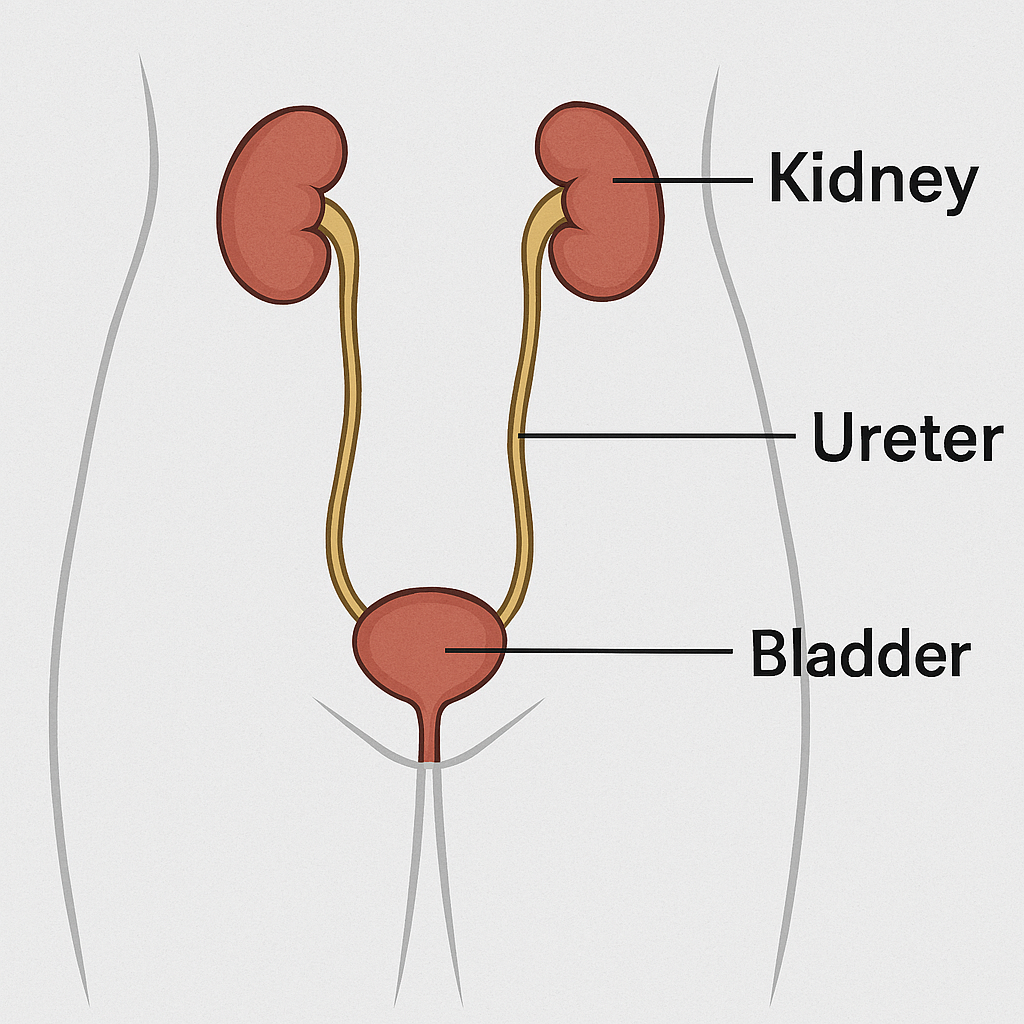
The JJ catheter is usually removed after a few weeks. Removal is a simple procedure performed under short anesthesia using a small camera inserted through the urinary tract.
- Kidney Drain (PCN – Percutaneous Nephrostomy)
- Bladder Catheter
- A catheter with a balloon inside the bladder (balloon catheter)
- A catheter without a balloon inside the bladder (splint)
- A catheter inserted directly into the bladder through the lower abdomen (suprapubic catheter – SPC / abdominal bladder catheter)
- Ureter Catheter
- JJ Catheter (Double-J Stent)
The JJ catheter is usually removed after a few weeks. Removal is a simple procedure performed under short anesthesia using a small camera inserted through the urinary tract.
Your child has one of the following:
If urine flow stops:
However, contact us without waiting if you notice increasing redness, swelling, pain, or foul smelling discharge.
During the first days, calm activities are recommended to avoid irritation of the treated area.
- Kidney drain
- Bladder catheter
- Ureter catheter
Daily Use
- Use the small leg bag during the day.
- Attach the larger drainage bag at night.
- Change the urine bags once a week.
- Additional supplies can be ordered using the form included in the care set.
Monitoring Urine Flow
Check daily whether urine is flowing properly.If urine flow stops:
- Check the tubing for kinks or bends.
- Gently straighten the tube if needed.
Monitoring the Catheter Exit Site
Check the skin around the catheter exit site daily. Mild redness or a small amount of discharge may be normal.However, contact us without waiting if you notice increasing redness, swelling, pain, or foul smelling discharge.
- Splint Draining into the Diaper
- Check that the diaper becomes regularly wet with urine.
- Ensure that urine is dripping from the splint. If no urine is observed, contact us without waiting.
- JJ Catheter – Urination Pattern
- During the day every 2–3 hours
- Around 11:00 PM before bedtime
- Early in the morning
During the first days, calm activities are recommended to avoid irritation of the treated area.
Only the checked information applies to your child.
- Your child should not shower during the first 2–3 days after surgery.
- Keep showers short. Gently pat the wound dry after showering.
- Your child should not take a bath during the first _____ days after surgery.
- When bathing is permitted, limit bath time to 5–10 minutes to prevent the wound from softening.
- Your child should not swim during the first ___ days/weeks after surgery.
- Your child should not participate in sports during the first ___ days/weeks after surgery.
- Your child should not ride a bicycle during the first ___ days/weeks after surgery.
- Your child should not lift heavy objects during the first ___ days/weeks after surgery.
During the recovery period after surgery, your child may need rest.
- Your child should not attend school or daycare for ___ days/weeks after surgery.
- After this period, your child may return according to the doctor’s advice.
After surgery, your child may need pain medication and, if necessary, other medicines. The prescribed medications and dosages will be determined by your doctor. (Only the checked and completed medications apply.)
Example schedule:
The times above are examples.
Medications must be administered according to the dosage, starting time, and dosing intervals prescribed by your doctor.
If necessary, administration times may be adjusted by 30–60 minutes.
If a dose is given later than planned, do not skip the medication. Continue according to the actual time given while maintaining the prescribed number of daily doses and required time intervals.
Pain Medication
After surgery, your child will need pain medication. You may give:- Paracetamol: [_____] mg, [_____] times a day
- Diclofenac: [_____] mg, [_____] times a day
- Nurofen: [_____] mg, [_____] times a day
- Tramadol: [_____] mg, [_____] times a day
- Oxynorm: [_____] mg, [_____] times a day
- Oxycontin: [_____] mg, [_____] times a day
- Butrans patch: [_____] mcg, every [_____] days
- Oxybutanine: [_____] mg, [_____] times a day
- Forlax/Movicolon: [_____] sachets, [_____] times a day
- Other medications: [____________________________________]
Example schedule:
| Frequency | Morning | Afternoon | Evening | Midnight |
| 4 times a day There must be 6 hours between medication intakes. | 06:00 | 12:00 | 18:00 | 00:00 |
| 3 times a day There must be 8 hours between medication intakes. | 08:00 | 16:00 | 00:00 | |
| 2 times a day There must be 8 hours between medication intakes. | 08:00 | 20:00 |
The times above are examples.
Medications must be administered according to the dosage, starting time, and dosing intervals prescribed by your doctor.
If necessary, administration times may be adjusted by 30–60 minutes.
If a dose is given later than planned, do not skip the medication. Continue according to the actual time given while maintaining the prescribed number of daily doses and required time intervals.
Medications can be collected from the Outpatient Pharmacy located in the Passage of Erasmus MC.
In exceptional cases, medications may be obtained from a local pharmacy. In that situation, the hospital will provide enough medication for the first 24 hours.
In exceptional cases, medications may be obtained from a local pharmacy. In that situation, the hospital will provide enough medication for the first 24 hours.
As your child’s pain decreases, medication should be reduced gradually. Do not stop all medications suddenly. Reduction should follow this order:
- First reduce prescription (stronger) pain medications.
- Then reduce paracetamol. Finally, give paracetamol only if your child has pain.
Stitches, Discharge Letter and Follow-up
Your child’s wound may have been closed using one of the following methods:
They usually fall off on their own after approximately 7 days.
If they do not fall off, you may gently remove them.
The stitches will be removed:
- Dissolvable Stitches
- Steri-strip Dressings
They usually fall off on their own after approximately 7 days.
If they do not fall off, you may gently remove them.
- Non-dissolvable Stitches
The stitches will be removed:
- By your General Practitioner (GP)
- During the hospital follow-up appointment
Your doctor will send a discharge letter to your General Practitioner (GP).
You can also view the discharge letter via the My Erasmus MC patient portal:
www.erasmusmc.nl/patientenzorg/mijn-erasmus-mc
You can also view the discharge letter via the My Erasmus MC patient portal:
www.erasmusmc.nl/patientenzorg/mijn-erasmus-mc
- Your child will return to the hospital for a follow-up examination.
- My Erasmus MC
- Letter by post
If so, this will be stated in the appointment notification.
- Your child does not require a follow-up appointment.
Situations Emotional Reactions
Hospital experiences can be challenging for children. Your child may need time to understand and emotionally process what has happened. The following reactions may occur:- Fear of being alone
- Sleep disturbances
- Bedwetting
If the symptoms persist, please contact your General Practitioner (GP).
Physiotherapy
Your child may require physiotherapy at home. If needed, you will receive a referral letter.Within the first 2 weeks after surgery, contact us without waiting if your child develops any of the following symptoms:
- Fever above 38.5 °C
- Redness or signs of infection at the wound site
- Increasing swelling around the wound
- Severe pain that does not improve with medication
- Persistent vomiting
- No urine output through the catheter (if a catheter is in place)
- Urine leakage around the catheter insertion site (if a catheter is used)
- Cloudy or foul-smelling urine
- Blood in the urine
- No bowel movement for 3 days or diarrhea lasting more than 3 days
Monday – Friday, 08:00–16:00
Pediatric urology Office (secretariaat kinderurologie): (010) 703 65 59
Outside these hours
Pediatric Surgery Ward: (010) 703 61 84
After 2 weeks following surgery
Please contact your General Practitioner (GP).
Pediatric urology Office (secretariaat kinderurologie): (010) 703 65 59
Outside these hours
Pediatric Surgery Ward: (010) 703 61 84
After 2 weeks following surgery
Please contact your General Practitioner (GP).
.........................................................................................................................................................................................................
.........................................................................................................................................................................................................
.........................................................................................................................................................................................................
.........................................................................................................................................................................................................
.........................................................................................................................................................................................................
.........................................................................................................................................................................................................
.........................................................................................................................................................................................................
.........................................................................................................................................................................................................
.........................................................................................................................................................................................................
